Real Estate House or Home Logo Set: Your Complete Branding Toolkit
Building a recognizable real estate brand starts with a powerful visual identity, and nothing anchors that identity quite like a well-crafted logo. Whether you're launching a new property management company, refreshing an existing brokerage, or creating marketing materials for a development project, having access to versatile design assets can save you countless hours and thousands of dollars. The Real Estate House or Home Logo Set offers exactly that—a comprehensive collection of building and property-themed logos designed to give professionals in the housing industry a polished, professional look from day one.
What Makes This Logo Collection Stand Out
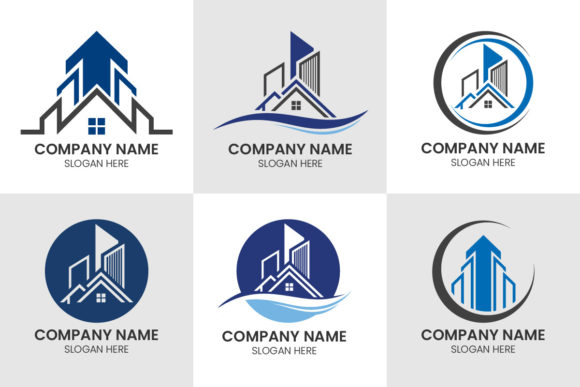
Unlike generic logo packs that offer a handful of uninspired designs, this collection brings together abstract home logos, skyscraper-inspired building designs, and modern estate branding elements that feel contemporary and sophisticated. Each design in the set captures the essence of property and real estate through clean lines, balanced compositions, and thoughtful symbolism. You'll find options ranging from minimalist geometric houses to more detailed architectural silhouettes, giving you the flexibility to match your brand's personality whether it leans toward luxury, accessibility, innovation, or tradition.
The visual appeal lies in the versatility. Some logos feature sleek, angular forms that suggest urban development and commercial property. Others use softer, rounded shapes that evoke warmth, family, and residential comfort. This range means you're not locked into a single aesthetic—you can explore different directions until you find the one that truly resonates with your target audience.
Practical Applications Across Every Touchpoint
One of the greatest strengths of a well-structured logo set is how many places you can use it. Think about every surface where your brand appears: business cards, yard signs, website headers, social media profiles, email signatures, property brochures, and even merchandise like branded polo shirts or tote bags. Having your logo available in multiple formats—AI, EPS, PNG, and JPG—means you're prepared for virtually any scenario without scrambling to convert files or hire a designer at the last minute.
For social media graphics, the high-resolution transparent PNG files are particularly valuable. Drop them onto any background—whether it's a photo of a newly listed property, a solid brand color, or a textured pattern—and they'll look crisp and professional. The JPG versions work beautifully for print materials like flyers, postcards, and magazine advertisements where you need reliable color reproduction and sharp detail at various sizes.
Web designers will appreciate the vector formats. Because the AI and EPS files are 100% vector, they scale infinitely without any loss of quality. That means your logo looks just as sharp on a tiny favicon as it does on a billboard. For anyone building a real estate website, this kind of flexibility is essential—you never know when a client will ask for a logo sized for an unexpected placement.
Editing and Customization Without the Headache
A logo is only useful if you can make it your own. This set is fully editable, which means you can change colors to match your existing brand palette, swap out fonts to align with your typography system, and adjust the overall composition to suit your specific needs. The files are organized cleanly, with layers that make sense even if you're not a seasoned graphic designer.
Speaking of fonts, the set uses free typefaces, which eliminates the worry about licensing fees for the text elements. This is a practical detail that many logo packs overlook. When you're building a brand on a budget, unexpected font licensing costs can throw off your entire plan. Knowing that the typography included won't require additional purchases gives you peace of mind and keeps your project moving forward.
The two AI file versions—compatible with both CS and CC editions of Adobe Illustrator—ensure that designers working with older software aren't left out. This kind of backward compatibility shows thoughtful file preparation, and it means you won't need to upgrade your software just to open and edit your new logo.
Strengthening Brand Recognition and Professional Presentation
Consistency is the foundation of brand recognition. When potential clients see the same logo, colors, and visual style across your website, your social media, your signage, and your printed materials, they begin to associate those elements with your business. Over time, that association builds trust. People start to recognize your brand before they even read your company name.
A professional logo set accelerates this process. Instead of cobbling together different design elements from various sources—which often results in a disjointed look—you start with a cohesive collection that's already been designed to work together. The abstract home logos and building estate logos in this set share a visual language, so even if you use different variations for different contexts, they'll still feel like they belong to the same family.
For small agencies and independent agents, this matters enormously. You're competing against established brokerages with dedicated marketing departments. A polished, consistent visual identity levels the playing field and signals to clients that you take your business seriously.
Choosing the Right Logo for Your Project
With multiple designs to choose from, it helps to think about your brand's personality before making a selection. Are you positioning yourself as a modern, tech-forward company? Look for the more geometric, abstract designs with clean lines and minimal detail. If your brand emphasizes luxury and exclusivity, the logos featuring sleek skyscraper elements might be the right fit. For family-oriented residential services, the warmer, more approachable house designs will resonate better with your audience.
Consider your primary use cases as well. If most of your marketing happens online, prioritize designs that read well at small sizes—logos with simpler shapes and fewer intricate details tend to hold up better when scaled down for social media profile pictures or mobile screens. If print is your focus, you have more freedom to choose detailed designs that reward closer inspection.
Don't overlook the power of testing. Before committing to a single logo, mock it up on a business card, a website header, and a yard sign. See how it looks in both color and black-and-white versions. Check it against your competitors' branding to make sure it stands out rather than blending in. These small steps during the selection process can save you from a costly rebrand down the road.
Maximizing Your Investment in Design Assets
Treat this logo set as a starting point, not a final destination. Use the included files to build out your complete brand identity system. Create a simple brand guide that specifies your primary and secondary colors, preferred logo variations for different contexts, and minimum size requirements. This document doesn't need to be elaborate—even a single-page PDF that you share with printers, web developers, and marketing partners will help maintain consistency across every channel.
Pair your chosen logo with complementary design assets. A strong sans-serif font works well for body copy and digital content, while a serif typeface can add sophistication to printed materials like property brochures and investor presentations. Think about how your logo, typography, color palette, and imagery work together to tell a cohesive story about who you are and what you offer.
The beauty of starting with a versatile, professionally designed logo set is that it gives you a solid foundation to build upon. As your business grows and your needs evolve, you can expand your brand identity without losing the core visual elements that your clients have come to recognize and trust. That kind of long-term value is what makes a quality design asset worth every penny—and every minute you invest in getting it right from the start.